
Category: CRM Solutions

  • Demystifying CRM Software Pricing Comparison: Finding the Best Deal for Your Business

    Demystifying CRM Software Pricing Comparison: Finding the Best Deal for Your Business

    So, you’re on the hunt for a Customer Relationship Management (CRM) system, and let’s be honest, trying to make sense of all the different options and their price tags can feel like solving a really complex puzzle. That’s where a solid CRM software pricing comparison comes into play. It’s not just about finding the cheapest option; it’s about finding the best value that aligns perfectly with your business needs without breaking the bank. Let’s dive into how to navigate this often-confusing landscape.

    Why CRM Software Pricing Comparison Matters

    Ignoring the specifics of CRM pricing can lead to overspending on features you don’t need or, worse, underspending and ending up with a system that can’t grow with you. A thorough CRM software pricing comparison helps you identify solutions that offer the right balance of functionality and affordability. Think of it as investing in a tool that will empower your sales, marketing, and customer service teams, ultimately driving revenue and improving customer satisfaction.

    Key Factors Influencing CRM Pricing

    When you’re doing your CRM software pricing comparison, you’ll quickly notice that prices aren’t one-size-fits-all. Several factors contribute to the final cost:

    Number of Users

    Most CRM vendors use a per-user, per-month pricing model. This means the more team members who need access to the CRM, the higher your monthly or annual bill will be. It’s crucial to accurately assess how many users will truly benefit from the system to avoid unnecessary costs.

    Feature Sets and Editions

    CRM platforms often come in various editions, like ‘Standard,’ ‘Professional,’ ‘Enterprise,’ or ‘Ultimate.’ Each tier unlocks more advanced features, integrations, and customization options. While a basic package might cover lead management and contact tracking, higher tiers could include advanced analytics, marketing automation, AI capabilities, or robust reporting. Always compare the features offered in each tier during your CRM software pricing comparison.

    Customization & Integrations

    Does your business have unique workflows or require deep integration with other tools you already use (like accounting software or email marketing platforms)? Some CRMs charge extra for advanced customization capabilities or for connecting to third-party applications. Ensure you factor these potential add-ons into your budget.

    Support and Training

    While basic support might be included, premium support (think 24/7 phone access, dedicated account managers, or faster response times) often comes at an additional cost. If your team needs extensive training or quick, expert assistance, investigate the pricing for enhanced support packages.

    Contract Length

    Opting for an annual contract often provides a discount compared to monthly billing. If you’re confident in your CRM choice, committing for a longer term can save you money. However, if you’re still testing the waters, a monthly plan offers more flexibility.
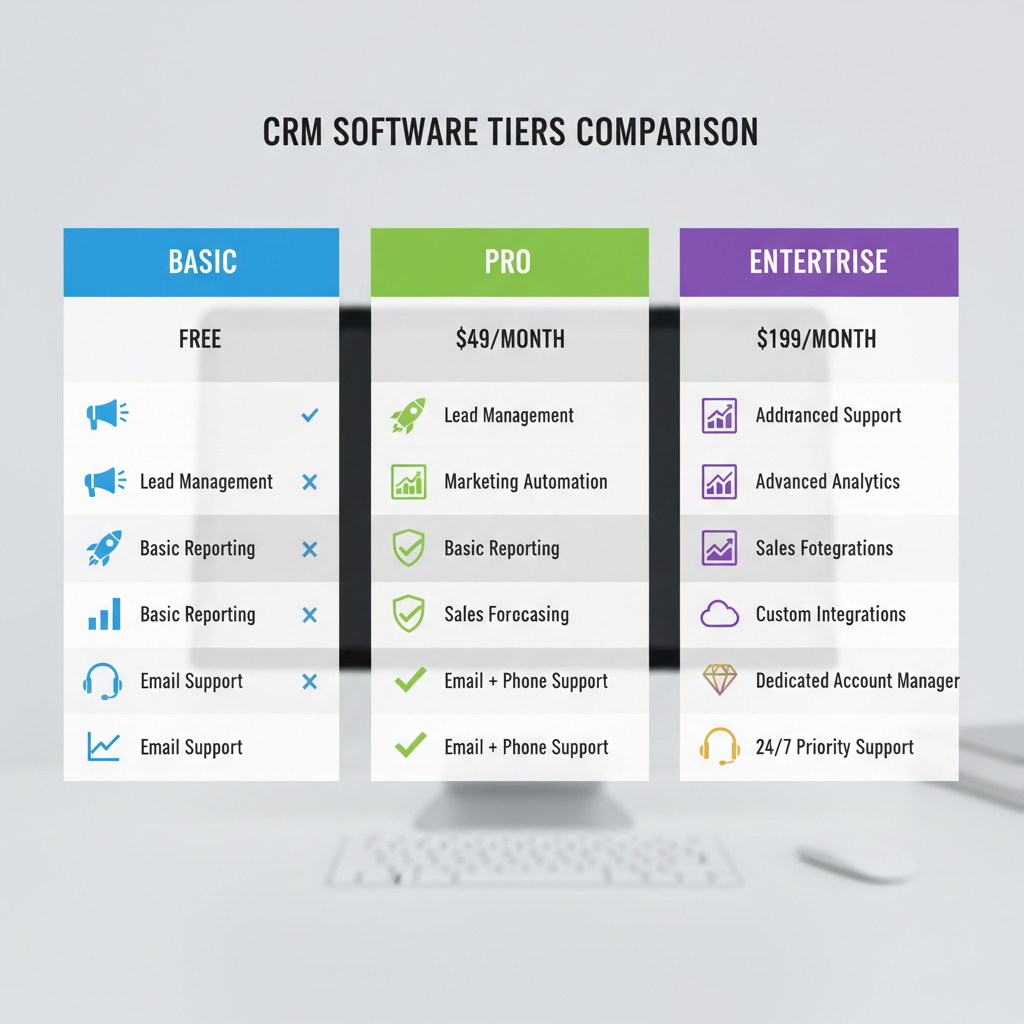
    A vibrant, detailed infographic comparing features of different CRM software tiers (Basic, Pro, Enterprise) with corresponding price indicators. The infographic should be clear, modern, and easy to understand, using icons for different features like 'lead management', 'marketing automation', 'reporting', and 'support level'.

    How to Approach Your CRM Software Pricing Comparison

    Don’t just look at the advertised price! Here’s a smart way to approach your comparison:

    • Identify Your Non-Negotiables: Before looking at prices, list the absolute must-have features your business needs. This helps you eliminate unsuitable options quickly.
    • Calculate Total Cost of Ownership (TCO): Look beyond the monthly subscription. Consider setup fees, training costs, integration costs, and potential future upgrades. A seemingly cheaper CRM might have hidden costs that inflate its TCO.
    • Read the Fine Print: Always check terms and conditions for any hidden fees, data limits, or cancellation policies.
    • Leverage Free Trials: Many CRM providers offer free trials. This is an excellent way to test out the software and see if it fits your team’s workflow before committing financially.

    A business professional happily reviewing a detailed spreadsheet showing a CRM software pricing comparison, with columns for 'Features', 'Users', 'Monthly Cost', 'Annual Cost', 'Setup Fees', and 'Total Cost of Ownership'. The background is a bright, modern office.

    Wrapping It Up

    Performing a thorough CRM software pricing comparison is a crucial step in choosing the right tool for your business. By understanding the factors that influence cost and carefully evaluating your specific needs, you can confidently select a CRM that not only fits your budget today but also supports your growth well into the future. Happy hunting for your perfect CRM solution!

  • Unlocking Excellence: Discovering the Top-Rated CRM for Customer Support

    Unlocking Excellence: Discovering the Top-Rated CRM for Customer Support

    Hey there! Ever wondered how some businesses just seem to nail their customer service every single time? Chances are, they’re rocking a Top-rated CRM for Customer support. In today’s fast-paced world, customer satisfaction isn’t just a bonus; it’s the backbone of business success. And that’s where a fantastic CRM comes into play, transforming how you interact with your customers and streamlining your support operations.

    Why a Top-Rated CRM is Your Customer Support Superpower

    Imagine a world where all customer interactions, queries, and history are at your fingertips, organized and accessible. That’s the magic of a powerful CRM system designed specifically for customer support. It’s not just about logging calls; it’s about building lasting relationships and providing lightning-fast, personalized service that keeps customers coming back.

    A vibrant, detailed image of a customer support team member smiling while helping a customer on a computer, with a modern CRM interface displayed on the screen. The office environment is bright and collaborative. Photorealistic, high resolution.

    What Makes a CRM Stand Out for Customer Support?

    So, what separates a good CRM from a Top-rated CRM for Customer support? It boils down to a blend of robust features, intuitive design, and the ability to truly empower your support team. We’re talking about tools that don’t just solve problems but predict them, making every customer interaction a breeze.

    Key Features of a Top-Rated CRM for Customer Support

    When you’re on the hunt for the best, keep an eye out for these crucial functionalities. These are the ingredients that make a CRM truly top-tier:

    • Unified Customer View: A 360-degree look at every customer, including past interactions, purchase history, and preferences.
    • Multi-Channel Support: Seamlessly manage support across email, chat, phone, social media, and more.
    • Automation Capabilities: Automate repetitive tasks like ticket routing, follow-ups, and data entry, freeing up your team.
    • Knowledge Base Management: Empower customers to find answers themselves with an easily searchable, self-service portal.
    • Analytics and Reporting: Gain insights into team performance, customer satisfaction, and areas for improvement.
    • Integration Prowess: Connects effortlessly with other tools you use, such as email marketing, project management, and e-commerce platforms.
    • Customization: The ability to tailor the CRM to fit your unique business processes and customer journey.

    Benefits You’ll Enjoy with a Top-Tier CRM

    Implementing a Top-rated CRM for Customer support isn’t just about fancy software; it’s about tangible improvements to your business’s health and customer happiness. Here’s what you can expect:

    1. Enhanced Customer Satisfaction: Quicker resolutions and personalized service lead to happier customers.
    2. Increased Agent Productivity: Automation and easy access to information mean agents can handle more queries efficiently.
    3. Improved Team Collaboration: Everyone on the team has access to the same up-to-date customer data, fostering better teamwork.
    4. Better Decision Making: Data-driven insights help you understand customer needs and optimize your support strategy.
    5. Reduced Operational Costs: Efficiency gains often translate into cost savings over time.

    A detailed, photorealistic image showing various data visualizations and charts on a CRM dashboard, illustrating customer support metrics like response time, customer satisfaction scores, and ticket resolution rates. The data is clear and actionable.

    Choosing the Right Top-Rated CRM for Your Business

    With so many options out there, how do you pick the perfect one? Start by assessing your business’s specific needs, budget, and future growth plans. Consider a free trial to get a hands-on feel for the system. Remember, the Top-rated CRM for Customer support for one business might not be the best for another. It’s all about finding the right fit for your unique customer service goals.

    Wrapping It Up

    Investing in a Top-rated CRM for Customer support is one of the smartest moves you can make for your business. It’s more than just a tool; it’s a strategic partner that helps you build stronger customer relationships, boost efficiency, and ultimately, drive growth. So go ahead, explore your options, and get ready to elevate your customer support game to legendary status!